Paramaribo Travel Guide: Exploring South America’s Historic Wooden City
If you were to close your eyes and picture a historic South American capital, your mind would likely drift to Spanish colonial plazas, sweeping stone cathedrals, and red-tiled roofs. But on the northeastern shoulder of the continent lies a city that completely shatters that geographical mold.
Welcome to Paramaribo, the vibrant capital of Suriname. Positioned gracefully along the wide banks of the Suriname River just fifteen kilometers inland from the Atlantic Ocean, Paramaribo—affectionately called “Par’bo” by locals—looks and sounds like nowhere else in the Americas. It is a place where Dutch civic architecture, Caribbean rhythms, and dense Amazonian hardwoods converge to create one of the most culturally diverse and visually arresting urban landscapes on Earth.
For the intrepid traveler seeking an authentic, off-the-beaten-path destination, here is your ultimate guide to exploring the historic wooden city of Paramaribo.
The UNESCO Jewel: A Fusion of Dutch Grid and Tropical Timber
In 2002, the Historic Inner City of Paramaribo was officially designated a UNESCO World Heritage site. Walking its streets, it is instantly clear why. Established as a Dutch colonial trading post in the 17th century, the city still retains its highly characteristic, symmetrical Dutch grid plan.
However, European settlers quickly realized that the stone and brick architecture of the Netherlands was entirely unsuited for the sweltering, humid climate of tropical South America. The solution? A brilliant architectural fusion.
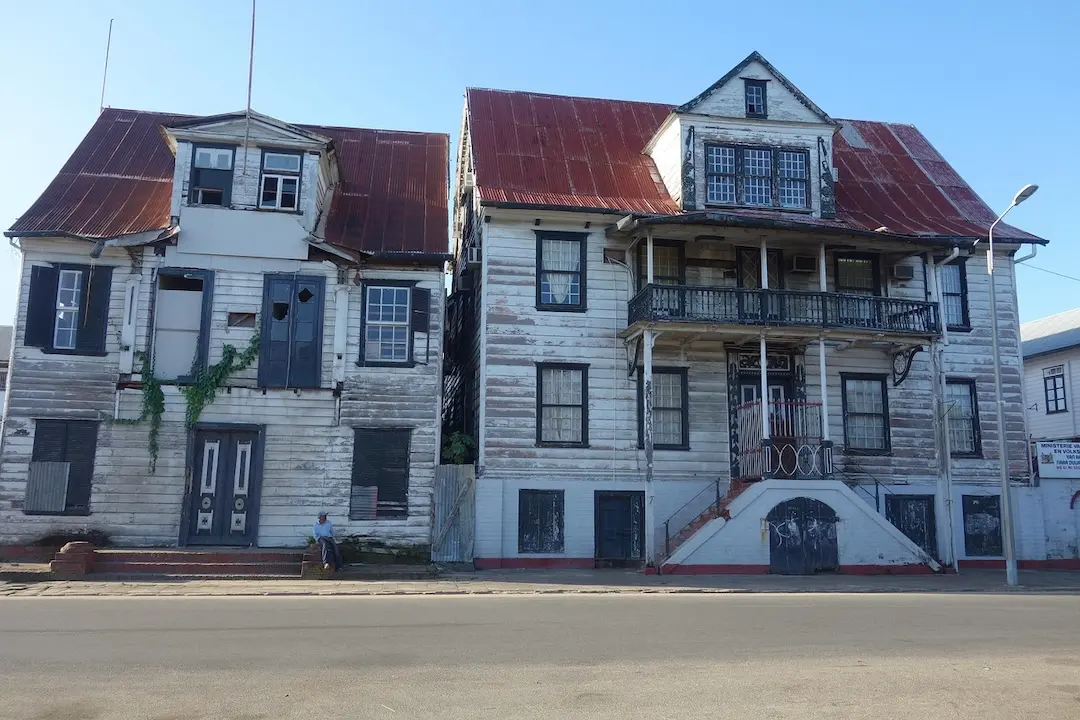
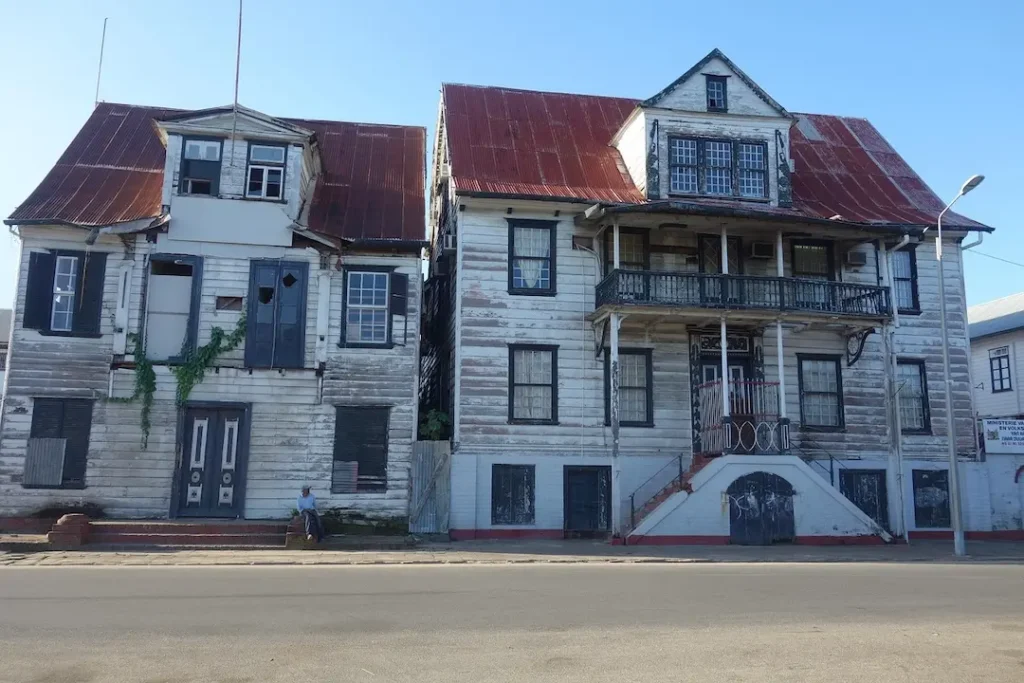
[Traditional Dutch Layout] + [Native Hardwoods] = Paramaribo Colonial ArchitectureColonial builders abandoned stone in favor of incredibly dense, termite-resistant native hardwoods like basralokus and bruinhart. To combat seasonal tropical flooding, they constructed high brick basements. To beat the equatorial heat, they added massive, wrap-around wooden galleries, soaring ceilings, and intricate jalousie blinds designed to funnel the cooling Atlantic trade winds through the living spaces.
What remains today is a striking urban landscape dominated by multi-story wooden townhouses painted in a crisp, uniform palette of stark white with dark green or black shutters. This local style stands out in beautiful, sharp contrast against the deep green of the surrounding tropical foliage.
Standing Inside a Legend: The Saint Peter and Paul Basilica
No architectural exploration of Paramaribo is complete without visiting its most defining landmark: the Cathedral-Basilica of Saint Peter and Paul (Sint-Petrus-en-Pauluskathedraal). Towering over the city center, this neo-Gothic masterpiece is celebrated as one of the largest entirely wooden structures in the Western Hemisphere.
Consecrated in 1885 with its twin spires finally completed in 1901, the basilica’s majestic gray-and-purple exterior is a sight to behold. But the true magic happens when you step across the threshold.
Inside, the humid tropical heat of the city seems to instantly evaporate, replaced by a cool, serene atmosphere and the faint, sweet scent of cedar. The entire interior is constructed from completely unpainted, unvarnished Surinamese cedar. The absence of paint allows the natural warmth, rich golden hues, and intricate grain of the native wood to take center stage. Looking up at the soaring vaulted ceilings feels less like entering a traditional church and more like stepping inside the beautifully crafted hull of a massive wooden ship.
Traveler Tip: The basilica is a functioning place of worship and a revered national monument. A strict dress code is enforced at the entrance by guards; visitors must ensure their shoulders are covered and avoid wearing shorts or short skirts.
Where History Began: Fort Zeelandia and the Waterkant
To understand how this multicultural enclave came to be, head to the banks of the river to explore Fort Zeelandia. This 17th-century pentagonal star fortress represents the literal birthplace of Paramaribo.
Originally a modest defensive post built by French colonists and later expanded by the British as Fort Willoughby, it was captured in 1667 by a Dutch squadron under Admiral Abraham Crijnssen. Renamed Fort Zeelandia in honor of the Dutch province that financed the fleet, the fortress guarded the colony’s lucrative plantation economy for centuries. Today, its historic brick bastions house the Surinaams Museum, offering an educational look into the area’s complex history, from indigenous archaeological relics to the dark realities of the transatlantic slave trade and indentured migration.
Fort Willoughby (British, 1650) ➔ Captured by Dutch (1667) ➔ Renamed Fort ZeelandiaJust outside the fortress gates lies the Waterkant (Waterfront), which serves as Paramaribo’s open-air living room. Lined with majestic mahogany trees and historic, high-gabled colonial mansions, this riverside promenade comes alive in the late afternoon.
As the sun begins to set over the Suriname River, locals and travelers alike gather at the Waterkant’s open-air food stalls. It is the perfect spot to sit back, crack open a cold, locally brewed Parbo Beer, and sample spicy Javanese noodles (bami) or a steaming bowl of saoto soup while watching cargo ships navigate the wide, tea-colored waters.
Palmentuin: A Royal Escape in the City Center
Directly behind the Presidential Palace lies the Palmentuin (Garden of Palms), a tranquil, shaded oasis right in the heart of downtown. This public park is home to hundreds of towering, decades-old Royal Palms, originally planted by a Dutch governor in the late 17th century.
Walking beneath the dense, whispering canopy of the Palmentuin provides a peaceful, shaded escape from the midday sun. The park is alive with the sounds of tropical birds, and on national holidays, it transforms into a bustling cultural hub filled with artisanal craft stalls and live local music.
Essential Paramaribo Travel Information
| Detail | What You Need to Know |
|---|---|
| Getting There | Most international travelers arrive via Johan Adolf Pengel International Airport (PBM), located roughly 45 minutes south of the city. |
| Getting Around | The historic inner city is compact and best explored entirely on foot. Taxis and local minibuses are readily available for longer trips. |
| Language | Dutch is the official language of government and education, but Sranan Tongo is the vibrant, English-based creole street language spoken by everyone. |
| Currency | The official currency is the Surinamese Dollar (SRD), though US Dollars and Euros are widely accepted in tourism sectors. |
Paramaribo is a city built on a foundation of resilience, timber, and profound cultural harmony. Whether you are looking up at the wooden vaults of its historic basilica, exploring the brick ramparts of Fort Zeelandia, or sharing a conversation with locals along the breezy Waterkant, this South American wooden wonder promises a travel experience that will resonate with you long after you leave its shores.